
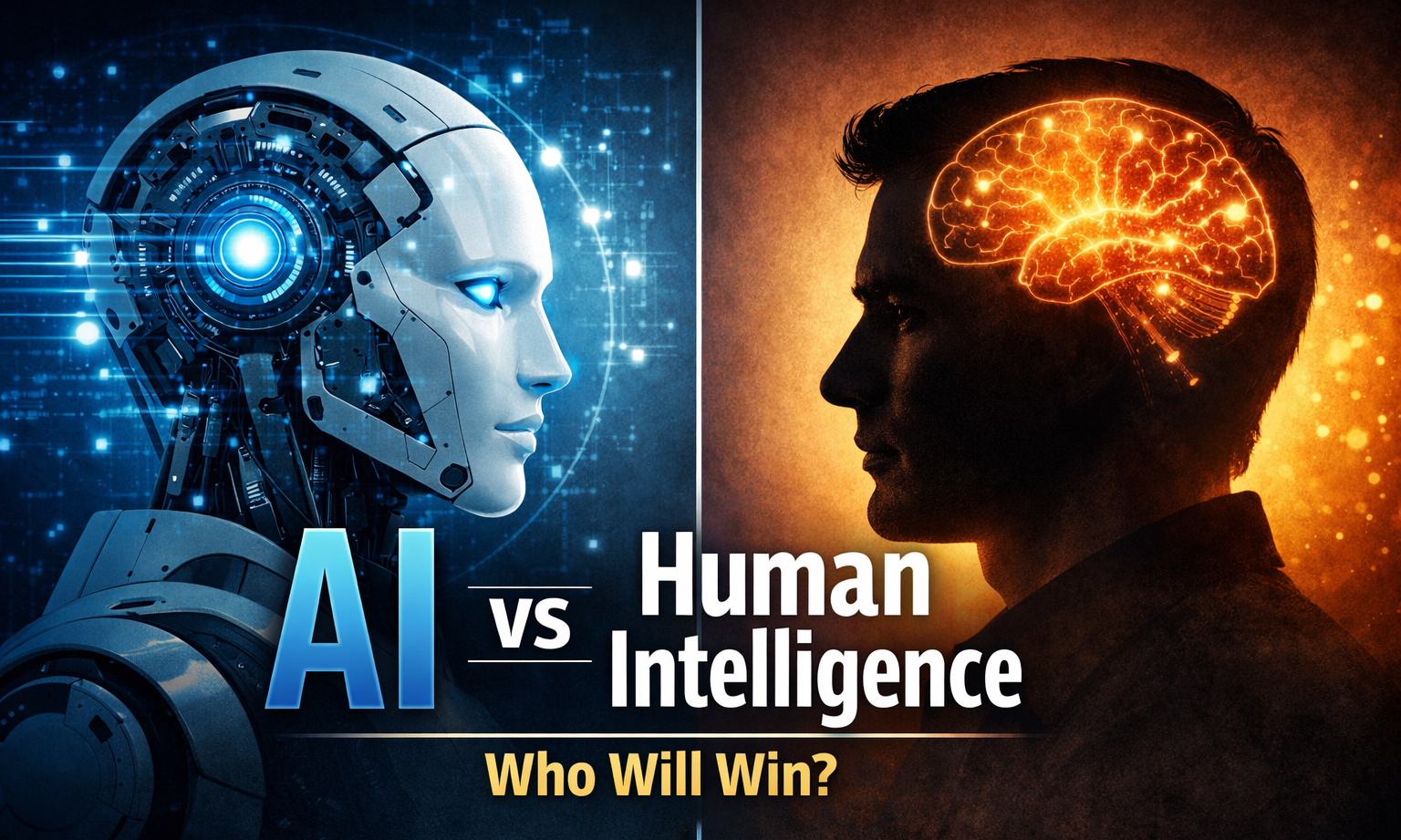
Artificial Intelligence (AI) has rapidly evolved from a futuristic concept into a powerful force shaping modern society. From virtual assistants and recommendation systems to self-driving vehicles and advanced data analysis, AI is now capable of performing tasks that once required human intelligence.
This rapid progress has sparked an important question:
Will artificial intelligence eventually surpass human intelligence — and if so, who will win?
The debate is not just technological; it touches philosophy, ethics, economics, and the future of humanity.
🧠 Understanding Human Intelligence
Human intelligence is complex and multifaceted. It includes:
- Logical reasoning
- Creativity
- Emotional understanding
- Moral judgment
- Adaptability
- Social interaction
Humans learn not only from data but also from experience, culture, and emotions. Human intelligence is deeply connected to consciousness and self-awareness.
🤖 Understanding Artificial Intelligence
Artificial Intelligence refers to computer systems designed to perform tasks that typically require human intelligence.
AI can:
- Analyze massive datasets
- Recognize patterns
- Predict outcomes
- Automate decisions
- Learn from data
Modern AI systems are especially powerful in areas requiring speed, precision, and large-scale computation.
⚡ Strengths of AI Over Humans
📊 1. Processing Speed
AI can analyze enormous amounts of information in seconds, far beyond human capability.
🔄 2. Consistency
AI systems do not get tired, distracted, or emotional, making them reliable for repetitive tasks.
🌐 3. Data Handling
AI can manage and interpret complex datasets that humans cannot process manually.
🚀 4. Automation
AI can perform tasks continuously without breaks, improving efficiency and productivity.
🎯 5. Precision
In areas like medical diagnosis or financial analysis, AI can achieve extremely high accuracy.
🧠 Strengths of Human Intelligence Over AI
🎨 1. Creativity
Humans can generate original ideas, art, stories, and innovations beyond existing patterns.
❤️ 2. Emotional Intelligence
Humans understand feelings, empathy, and social nuances — areas where AI struggles.
🧩 3. Common Sense Reasoning
Humans can make judgments in unfamiliar situations using intuition and experience.
⚖️ 4. Moral and Ethical Thinking
Humans consider values, ethics, and consequences, while AI follows programmed objectives.
🌍 5. Adaptability
Humans can adapt to new environments without needing massive retraining.
⚔️ AI vs Humans in Different Fields
🏭 Industry & Manufacturing
AI dominates repetitive and precision-based tasks.
🧑⚕️ Healthcare
AI assists doctors but cannot replace human judgment and empathy.
🎨 Creative Fields
Humans still lead in originality, storytelling, and artistic expression.
📊 Data Analysis
AI outperforms humans in processing large datasets quickly.
🤝 Social Interaction
Human communication remains richer and more nuanced.
🔐 Risks of AI Surpassing Human Intelligence
Some experts warn about potential risks if AI becomes too powerful:
- Loss of jobs due to automation
- Dependence on machines
- Ethical concerns about decision-making
- Security risks from autonomous systems
- Lack of human control
These risks highlight the need for responsible AI development.
🌍 Collaboration Instead of Competition
Many researchers believe the future is not AI vs Humans, but AI + Humans.
AI excels at:
- Speed
- Accuracy
- Data processing
Humans excel at:
- Creativity
- Leadership
- Emotional understanding
- Strategic thinking
Together, they can achieve outcomes neither could accomplish alone.
💼 Impact on Jobs and Careers
AI will transform the workforce by:
- Automating routine jobs
- Creating new technology-driven roles
- Increasing demand for creative and analytical skills
- Shifting focus toward human-centered professions
Future success will depend on adapting to AI-enhanced environments.
🔮 Could AI Become Self-Aware?
Currently, AI systems are not conscious. They operate based on algorithms and data rather than true understanding.
However, researchers continue exploring advanced AI models that may exhibit more autonomous behavior.
Whether AI will ever achieve true consciousness remains an open question.
🌐 AI and Human Evolution
AI may become an extension of human capability rather than a replacement.
Examples include:
- Brain-computer interfaces
- AI-assisted decision-making
- Smart prosthetics
- Personalized digital assistants
Technology could enhance human intelligence rather than compete with it.
🧾 Final Verdict: Who Will Win?
The question of AI vs Human Intelligence does not have a simple winner.
AI will likely dominate tasks involving:
- Speed
- Data processing
- Automation
- Precision
Humans will continue to lead in areas requiring:
- Creativity
- Ethics
- Emotional connection
- Complex problem-solving
Ultimately, the future is not about victory but about balance and collaboration.
🧾 Final Thoughts
Artificial Intelligence is one of the most transformative technologies in human history. While it surpasses humans in specific capabilities, it lacks the emotional depth, creativity, and consciousness that define human intelligence.
Rather than replacing humans, AI is reshaping how we work, think, and interact with technology.
The real challenge is not whether AI will win — but whether humanity can guide AI development responsibly to benefit society.
🔗 Official References & Further Reading
For trusted insights on AI and its future, you can explore:
- https://www.weforum.org/topics/artificial-intelligence
- https://www.ibm.com/artificial-intelligence
If you cannot access these links, this article already summarizes key perspectives on AI and human intelligence.