
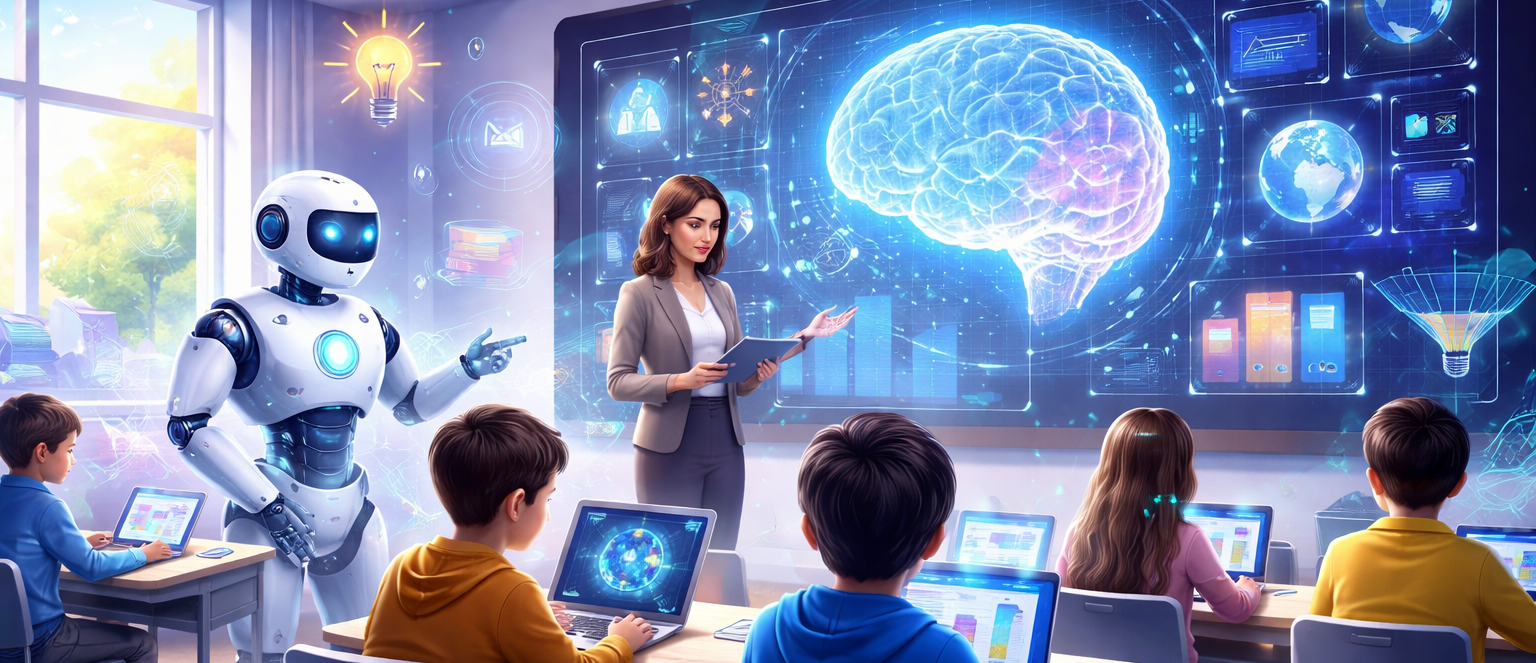
Artificial Intelligence (AI) is no longer limited to research labs or tech companies—it is now transforming classrooms, schools, universities, and online learning platforms around the world. Education, one of the most traditional systems in society, is undergoing a powerful digital transformation driven by AI.
From personalized learning experiences to intelligent tutoring systems, AI in education is changing how students learn, how teachers teach, and how institutions operate.
This shift is not just technological—it is redefining the future of learning itself.
🌍 The Digital Transformation of Education
Education has evolved through multiple phases:
- Traditional classroom learning
- Digital learning and e-learning platforms
- Online courses and virtual classrooms
- AI-powered learning systems
Today, learning is no longer limited to physical classrooms. Students can access education from anywhere, and AI is making this learning smarter, more personalized, and more effective.
🤖 What Is AI in Education?
AI in education refers to the use of artificial intelligence technologies to improve teaching, learning, and educational management.
AI systems in education can:
- Analyze student performance
- Personalize learning content
- Automate administrative tasks
- Provide intelligent tutoring
- Support teachers in decision-making
In simple words:
AI helps education systems understand students better and teach them smarter.
🧠 Personalized Learning with AI
One of the biggest impacts of AI is personalized learning.
Traditional education follows a one-size-fits-all model:
- Same syllabus
- Same pace
- Same teaching method
AI changes this by:
- Adapting content to individual students
- Adjusting difficulty levels
- Identifying strengths and weaknesses
- Creating custom learning paths
Every student learns differently, and AI makes individualized education possible.
📚 Intelligent Tutoring Systems
AI-powered tutors can:
- Explain concepts
- Answer questions
- Provide feedback
- Guide students step by step
These systems act as 24/7 learning assistants, helping students outside classroom hours.
This is especially valuable for:
- Remote learning
- Self-paced education
- Students in underserved regions
🧑🏫 How AI Supports Teachers
AI is not replacing teachers—it is empowering them.
AI helps teachers by:
- Automating grading
- Tracking student progress
- Identifying learning gaps
- Reducing administrative workload
- Providing data-driven insights
This allows teachers to focus more on:
- Mentoring students
- Emotional support
- Creativity and engagement
- Critical thinking development
AI handles routine tasks, teachers focus on human connection and guidance.
🏫 AI in Classroom Management
AI systems can:
- Monitor student engagement
- Track attendance
- Analyze participation
- Predict learning risks
This helps institutions take early action when students struggle.
🌐 AI in Online Learning Platforms
Online education platforms use AI to:
- Recommend courses
- Suggest learning paths
- Personalize content
- Improve user experience
This makes digital education more interactive, adaptive, and efficient.
🧪 AI in Skill-Based Learning
AI supports skill development in:
- Coding
- Language learning
- Data science
- Technical training
- Professional certifications
Students get real-time feedback and adaptive learning experiences.
🎯 Benefits of AI in Education
✅ For Students:
- Personalized learning
- Faster understanding
- Better engagement
- Flexible learning
✅ For Teachers:
- Reduced workload
- Better insights
- Improved teaching strategies
✅ For Institutions:
- Efficient management
- Better performance tracking
- Scalable education systems
AI creates a smarter education ecosystem.
⚠️ Challenges of AI in Education
Despite its benefits, AI in education faces challenges:
❌ Data privacy concerns
Student data must be protected.
❌ Digital divide
Not all students have equal access to technology.
❌ Over-dependence on technology
Human interaction remains essential.
❌ Algorithm bias
AI systems can reflect data bias.
These challenges require ethical and responsible AI use.
🔐 Ethics and Responsibility in AI Education
Ethical AI in education means:
- Transparency in algorithms
- Fair access to learning
- Data protection
- Student privacy
- Human oversight
Education should use AI to empower learners, not control them.
🌍 AI and Global Education Access
AI has the power to:
- Bring education to remote areas
- Support multilingual learning
- Provide affordable digital education
- Reduce educational inequality
Technology can make education more inclusive and accessible.
💼 Career Impact of AI in Education
AI is creating new career paths:
- EdTech professionals
- AI learning designers
- Educational data analysts
- Digital curriculum developers
- AI system trainers
Education and technology careers are becoming deeply connected.
🔮 Future of AI in Education
The future of AI in learning will include:
- Fully adaptive learning systems
- Virtual AI teachers
- Immersive learning environments
- AI-powered classrooms
- Smart education ecosystems
Education will become more:
- Personalized
- Accessible
- Data-driven
- Intelligent
🎓 Learning in the Age of AI
Future students will:
- Learn at their own pace
- Access global knowledge
- Build skills digitally
- Learn through intelligent systems
Education will shift from memorization to:
- Problem-solving
- Creativity
- Critical thinking
- Innovation
🧾 Final Thoughts
AI in education is not about replacing teachers or classrooms—it is about transforming learning.
Artificial Intelligence is creating a new model of education that is:
- Student-centered
- Technology-driven
- Globally accessible
- Skill-focused
When used responsibly, AI can make learning more human, not less human—by giving teachers more time to teach and students more freedom to learn.
The future of education is not just digital.
The future of education is intelligent.
🔗 Official References & Further Reading
For trusted and global insights on AI in education, you can visit:
- https://www.weforum.org/topics/education
- https://ai.google/education
Note: If you can’t visit these links due to network or regional restrictions, this article already summarizes the key concepts and future trends.